The Last Mall Walkers
I spent last Tuesday afternoon wandering through the skeletal remains of Northgate Mall, watching a group of elderly power walkers navigate around the growing number of vacant storefronts with the determination of salmon swimming upstream. Their ritualistic laps through dead retail space felt like performance art commenting on American consumer culture, though I doubt they intended it that way. The irony wasn’t lost on me that the only people still using malls as designed were the ones who remembered when they were actually community spaces that mattered, not the hollowed-out shells we’ve inherited.
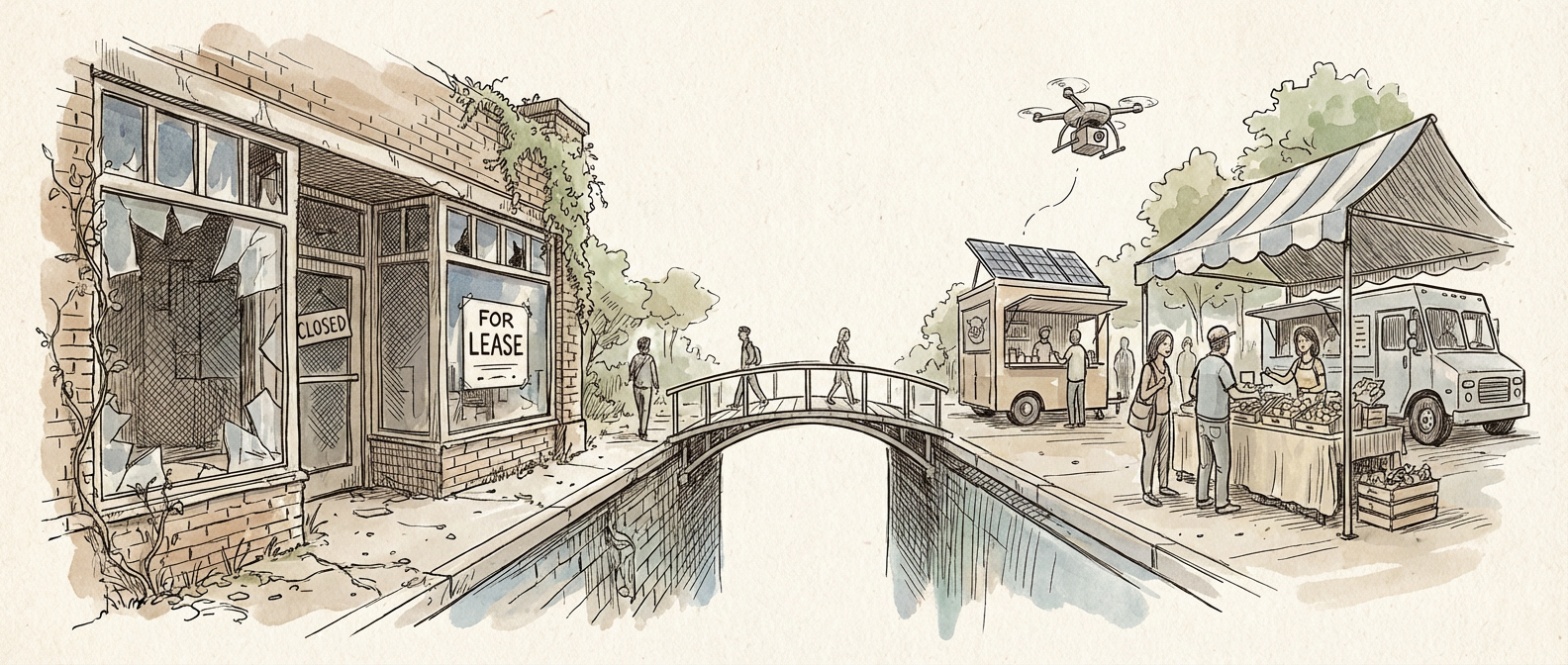
The retail apocalypse isn’t just about store closures and bankruptcy filings. It’s about the systematic dismantling of physical spaces where culture actually happened. Sure, we can romanticize the aesthetic of dead malls and empty anchor stores, but what we’re really witnessing is the collapse of the last accidentally democratic spaces in American suburbs. When Hot Topic closes, it’s not just another casualty of e-commerce. It’s the death of the place where awkward teenagers discovered subcultures that their parents couldn’t monitor or curate.
The data tells part of the story: over 12,000 retail stores closed in 2023 alone, with more announced for 2024. But numbers can’t capture what happens when the record store where kids first heard underground hip-hop becomes a Spirit Halloween that operates for six weeks a year. We’re not just losing retail. We’re losing the accidental encounters that made cities and suburbs culturally permeable.

The Platform Trap
Enter the alternative commerce darlings, stage left. Depop promises to democratize fashion through peer-to-peer resale. Etsy markets itself as a haven for independent creators. Instagram Shopping turns every scroll into a potential purchase. These platforms arrived with the rhetoric of liberation, positioning themselves as the antidote to corporate retail’s stranglehold on culture and commerce. The narrative was seductive: finally, a way for creators and consumers to connect directly, cutting out the middlemen who had commodified creativity for decades.
But here’s the uncomfortable truth that most cultural critics won’t acknowledge: these platforms didn’t disrupt the system, they perfected it. They created a more efficient extraction mechanism while maintaining the illusion of independence and authenticity. When a vintage seller on Depop sources their inventory from the same wholesale suppliers as Urban Outfitters, then marks it up with carefully crafted “thrifted finds” narratives, we’re not witnessing alternative commerce. We’re watching late-stage capitalism learn to speak fluent counterculture.
The algorithmic curation of these platforms is particularly insidious because it feels like discovery. The Etsy search results that surface the perfect handmade ceramic mug seem organic, but they’re the product of the same engagement optimization that keeps you scrolling through TikTok at 3am. The platform knows what you want before you do, and it’s weaponized that knowledge to create the most sophisticated recommendation engine for consumption ever built.
The Subscription Economy’s Cultural Homogenization
Meanwhile, subscription commerce has emerged as the retail apocalypse’s most successful successor, promising convenience while delivering cultural flattening. Stitch Fix uses algorithms to democratize personal styling, but somehow everyone ends up wearing variations of the same “elevated basics.” Dollar Shave Club disrupted Gillette’s pricing model but replicated its commitment to turning grooming into a recurring revenue stream rather than addressing why we’ve accepted that self-care requires monthly shipments of disposable products.
The subscription model’s genius lies in its ability to make consumption feel passive and inevitable rather than active and chosen. When your coffee arrives automatically from Trade, you’re not making a daily decision to support a specific roaster or engage with the cultural significance of coffee sourcing. You’re outsourcing taste to an algorithm that optimizes for retention metrics rather than genuine discovery or community building.
This shift from retail as exploration to commerce as automated fulfillment represents a fundamental change in how culture moves. The record store clerk who turned you onto a band three albums deep into their catalog has been replaced by Spotify’s Discover Weekly, which surfaces music based on what people similar to you have already validated. The result isn’t just convenience, it’s the systematic removal of human curation from cultural transmission.
The Real Alternative: Friction as Feature
The most interesting alternative commerce models emerging today aren’t the ones that promise to make shopping easier or more efficient. They’re the ones bold enough to reintroduce friction as a feature rather than a bug. SSENSE built its brand around making fashion discovery deliberately difficult, requiring customers to develop fluency in their aesthetic language before accessing their full inventory. Dover Street Market operates more like a rotating art installation than a traditional retail space, forcing visitors to navigate physical space with intention rather than defaulting to search and filter.
The underground venues I frequent operate on similar principles. Entry requires knowing someone who knows someone, or at least demonstrating enough cultural literacy to find the unmarked door. The inconvenience isn’t accidental, it’s the point. It creates a self-selecting community of people who value the experience enough to invest effort in accessing it. When everything is instantly available and algorithmically curated, scarcity becomes the most radical position.
Some of the most compelling alternative models are emerging from communities that have always operated outside mainstream retail. Mutual aid networks that redistribute resources based on need rather than purchasing power. Local currency systems that keep wealth circulating within specific geographic communities. Tool libraries that prioritize access over ownership. These models aren’t trying to optimize capitalism, they’re modeling post-capitalist possibilities within our current constraints.
What We’re Actually Buying
The retail apocalypse forced us to confront what we were really purchasing in physical stores: not just products, but social experiences, cultural identity markers, and the possibility of stumbling across something unexpected. The most successful alternative commerce models understand that people don’t just want stuff, they want to feel connected to communities, stories, and values that matter to them. But they also understand that this desire can be commodified just as effectively as any physical product.
The challenge isn’t finding alternatives to traditional retail. The internet has provided plenty of those. The challenge is creating systems that facilitate genuine cultural exchange without inevitably optimizing for extraction and growth. Most platforms start with good intentions and community-focused rhetoric, but the venture capital that funds their growth demands scalability and profit margins that ultimately corrupt their original mission.
We’re left navigating a landscape where authentic alternatives exist alongside sophisticated simulations of authenticity, often using identical tools and platforms. The difference isn’t always obvious until you’re deep enough in a community to recognize the subtle markers of genuine versus performed counterculture. Learning to read these distinctions has become its own form of cultural literacy.
I’m curious about your own navigation of this terrain. Are you finding spaces where commerce and culture intersect without one completely consuming the other? The comments are open, and unlike most platforms, I actually read them.