When the Malls Died, Something Else Was Born
The retail apocalypse wasn’t just about department stores closing and anchor tenants fleeing suburban shopping centers. It was the death rattle of a particular kind of cultural transmission, one where taste was manufactured in boardrooms and distributed through climate-controlled temples of consumption. What emerged from those empty storefronts wasn’t just Amazon warehouses and pop-up Halloween stores. It was something far more interesting and infinitely more complex: a fractured, hyperlocal network of alternative commerce that operates according to entirely different rules.
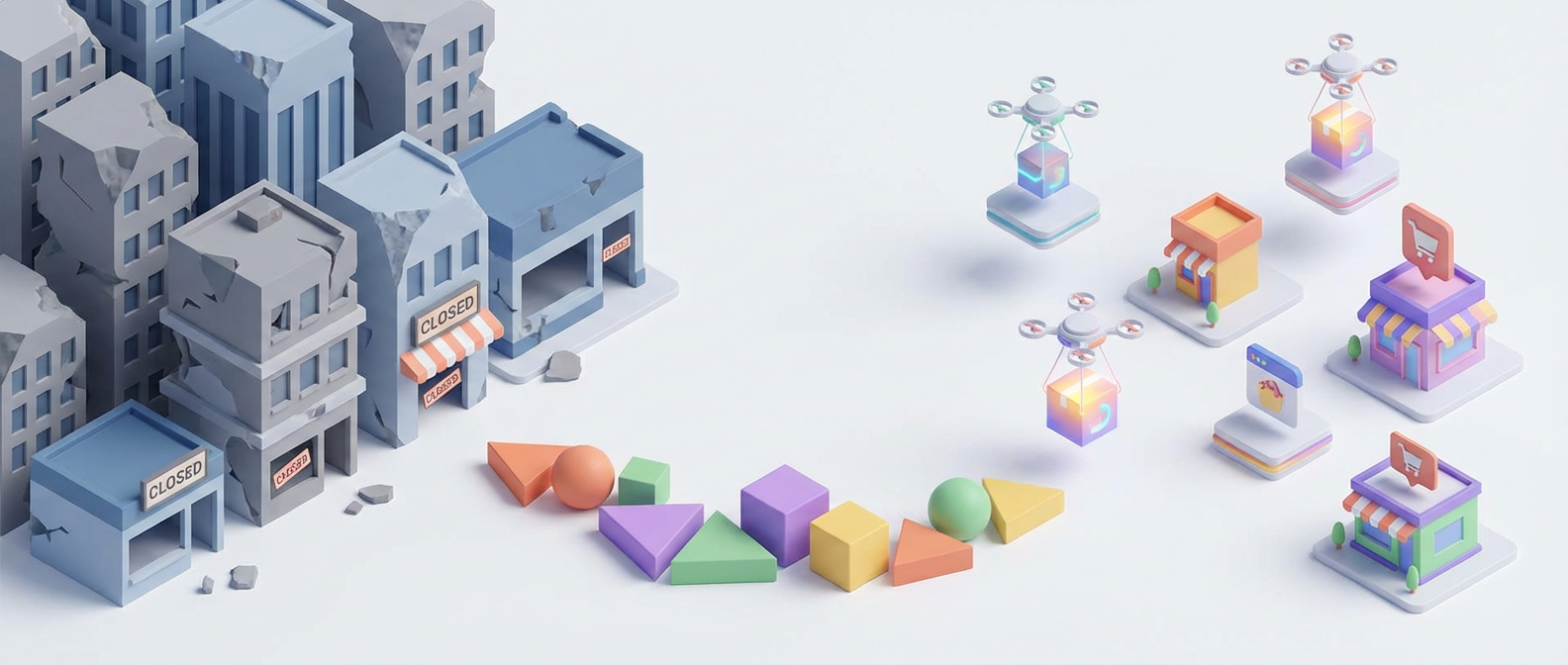
I’ve been tracking this shift for years now, from the popup markets in abandoned strip malls to the Instagram-based vintage dealers who treat their feeds like curated gallery spaces. The underground economy that’s replacing traditional retail isn’t just selling different products. It’s selling different relationships to consumption entirely. Where mainstream retail trained us to want what everyone else wanted, these new models thrive on exclusivity, authenticity, and the kind of cultural capital that can’t be mass-produced.
The numbers tell one story: retail square footage per capita has been declining since 2005, with over 12,000 store closures in 2020 alone. But the real story is what you can’t quantify. The spaces where culture once gathered around shared commercial experiences have been split into a thousand micro-scenes, each with its own aesthetic codes, distribution networks, and gatekeeping mechanisms. We’re not just shopping differently. We’re relating to objects, to each other, and to the concept of coolness itself in completely new ways.
The Algorithmic Taste Wars
Platform capitalism didn’t kill retail culture so much as it devoured it and spat out something unrecognizable. The same algorithms that can predict what you’ll want to buy next have created feedback loops that make genuine discovery increasingly rare. When every vintage band tee is reproduced by Urban Outfitters within six months of appearing on TikTok, the half-life of underground aesthetics has compressed to near-zero.
But here’s where it gets interesting: the people who really understand culture have learned to game this system in reverse. The best curators I know treat platforms like Instagram and Depop as distribution mechanisms while keeping their actual sourcing networks completely opaque. They’ll post a single image of a 1990s Helmut Lang piece without tagging the brand, knowing that their real customers will recognize it immediately while the algorithm remains clueless. It’s cultural arbitrage on a massive scale.
The uncomfortable truth is that this new system is both more democratic and more elitist than what came before. Anyone with a phone can theoretically become a dealer, but the real money flows to those with the cultural fluency to spot trends before they turn into content. The kids making serious money aren’t just buying and selling clothes. They’re trafficking in the much more valuable commodity of being early to something that matters.
Community as Currency
The most successful alternative commerce models understand something that traditional retail never quite grasped: people don’t just want products, they want membership in communities that those products represent. The monthly clothing swap in my neighborhood warehouse doesn’t just redistribute garments. It works as a social sorting mechanism, a way for people to signal their values while building the kinds of weak-tie networks that drive actual cultural change.
These models succeed precisely because they’re inefficient by traditional metrics. The popup that only announces its location two hours before opening, the Telegram channel where rare sneakers are sold through elaborate social games, the subscription box curated by someone whose taste you trust completely. None of these would make sense to a McKinsey consultant, but they work because they create scarcity and intimacy at the same time.
What’s emerging is a kind of post-retail feudalism, where access to the coolest stuff depends not on your purchasing power alone but on your position within specific cultural networks. The barrier to entry isn’t just economic. It’s social, aesthetic, and increasingly, ideological. You need to know not just what to buy, but how to signal that you understand why it matters.
The Authenticity Trap
The obsession with authenticity that drives much alternative commerce contains its own contradictions. The same people who rail against fast fashion will spend absurd amounts on vintage pieces that have been artificially distressed to look more authentic than they actually are. The underground market for “deadstock” items that never actually sold in the first place reveals how deeply we’ve internalized the logic of artificial scarcity.
Even worse, the rhetoric of supporting small businesses and independent creators often masks the reality that many of these “authentic” alternatives are just as extractive as the systems they claim to replace. The Depop seller flipping thrift store finds at 400% markup is still participating in the same logic of accumulation, just with better branding and a more compelling origin story.
The uncomfortable question is whether these alternative models represent genuine resistance to capitalist logic or just its evolution into more sophisticated forms. When buying vintage becomes a way to signal environmental consciousness while still engaging in conspicuous consumption, we’re not escaping the system so much as creating new ways to feel good about participating in it.
What Happens After the Alternative
The real test of these new commerce models won’t be whether they can maintain their current level of cultural cachet, but whether they can scale without losing the very qualities that made them appealing in the first place. Every underground market that becomes visible enough to attract mainstream attention faces the same choice: maintain exclusivity and remain niche, or expand and risk becoming exactly what it was supposed to replace.
Some of the most interesting experiments are happening at this exact tension point. The clothing brand that releases everything through elaborate ARGs that require genuine community participation to access. The record label that distributes exclusively through a network of independent bookstores. These models suggest possibilities for commerce that creates genuine cultural value rather than simply extracting it.
But they also reveal how exhausting it’s become to participate in culture authentically. When buying anything requires navigating complex networks of social signaling and cultural positioning, consumption itself becomes a form of labor. The cognitive overhead of staying cool in 2024 makes the old model of walking into a mall and buying whatever was in the window seem almost quaint.
The question isn’t whether these alternative models will replace traditional retail. They already have, for the people who matter most to cultural production. The question is what happens when everyone else figures out how the new system works. And whether there will be anything left worth buying when they do.