When the Pottery Wheel Stopped Spinning
There was a moment, somewhere around spring 2024, when every person you knew seemed to be throwing clay. Your Instagram feed had become a gallery of wonky bowls and hand-built vessels. Local pottery studios had waitlists stretching months into the future. The ceramics renaissance, which had been building quietly for years beneath the wellness-industrial complex, had finally reached critical mass. It felt like the future of art. It felt like something real.
Then it stopped.
The decline was neither sudden nor dramatic. It was the kind of cultural shift that only registers once you start paying attention to the metrics. Global searches for “pottery classes near me” peaked in the second quarter of 2024, which tracks perfectly with what we all observed in our own cities—the opening of seventeen new ceramic studios, the influencer collaborations, the branded pottery kits sold at Target. By early 2026, that search volume had dropped by 22 percent. Not catastrophic. But undeniable. The trend had moved past its fever pitch into something resembling a normalized activity, which is precisely when the underground loses interest.
This is how subcultures work. They’re allergic to saturation. The moment something becomes accessible, becomes teachable in strip malls, becomes something your mom’s friend can do on a Tuesday afternoon, the early adopters have already moved three steps ahead to something nobody else has heard of yet.
The Shift Beneath Our Feet
If ceramics represented the soft, meditative turn in contemporary art—the handmade as antidote to digital alienation—what comes next had to be something harder. Something that refuses the Instagram aesthetic of a perfectly glazed mug. Something with actual weight.
Between January and October of 2025, searches for “ferro cement sculpture” and “hypertufa art objects” increased by 180 percent year-over-year on Etsy. That’s not just growth. That’s a wholesale migration of creative energy. The platform’s Etsy Trend Report 2025 put these industrial material searches alongside searches for rebar composite work and concrete casting, a clear signal that the zeitgeist was ready for something with texture, with brutality, with the aesthetic of infrastructure.
Ferro cement, for those unfamiliar, is a composite material made by layering cement and sand over a framework of steel mesh or rebar. It’s the material used to build water tanks, boat hulls, structural reinforcements. It’s industrial. It’s utilitarian. It carries none of the precious femininity associated with handthrown ceramics. And that’s precisely why artists started claiming it as a legitimate sculptural medium.
The material carries history in a different register than clay does. Ceramics speak to individual craft and personal expression. Ferro cement speaks to collective infrastructure, to the bones of cities, to the systems we build to hold ourselves up. It’s a material that refuses to be precious. It resists the commodification that consumed the ceramics trend almost as soon as it peaked.
The Numbers Tell a Story of Migration
At the November 2025 NADA Art Fair Emerging Trends report, emerging artist booths featuring sculptural work in industrial materials like ferro cement and rebar composite had grown to represent 19 percent of the fair’s programming. In 2022, this figure sat at 3 percent. That’s not incremental growth. That’s a complete recalibration of what “emerging” means in contemporary sculpture.
The supply chain followed the demand. Blick Art Materials, one of the largest art retailers in North America, recorded a 290 percent increase in ferro cement and structural additive sales through their online store between the first quarter of 2025 and the first quarter of 2026. Artists were buying. Seriously buying. Not as a passing curiosity but as a committed material practice.
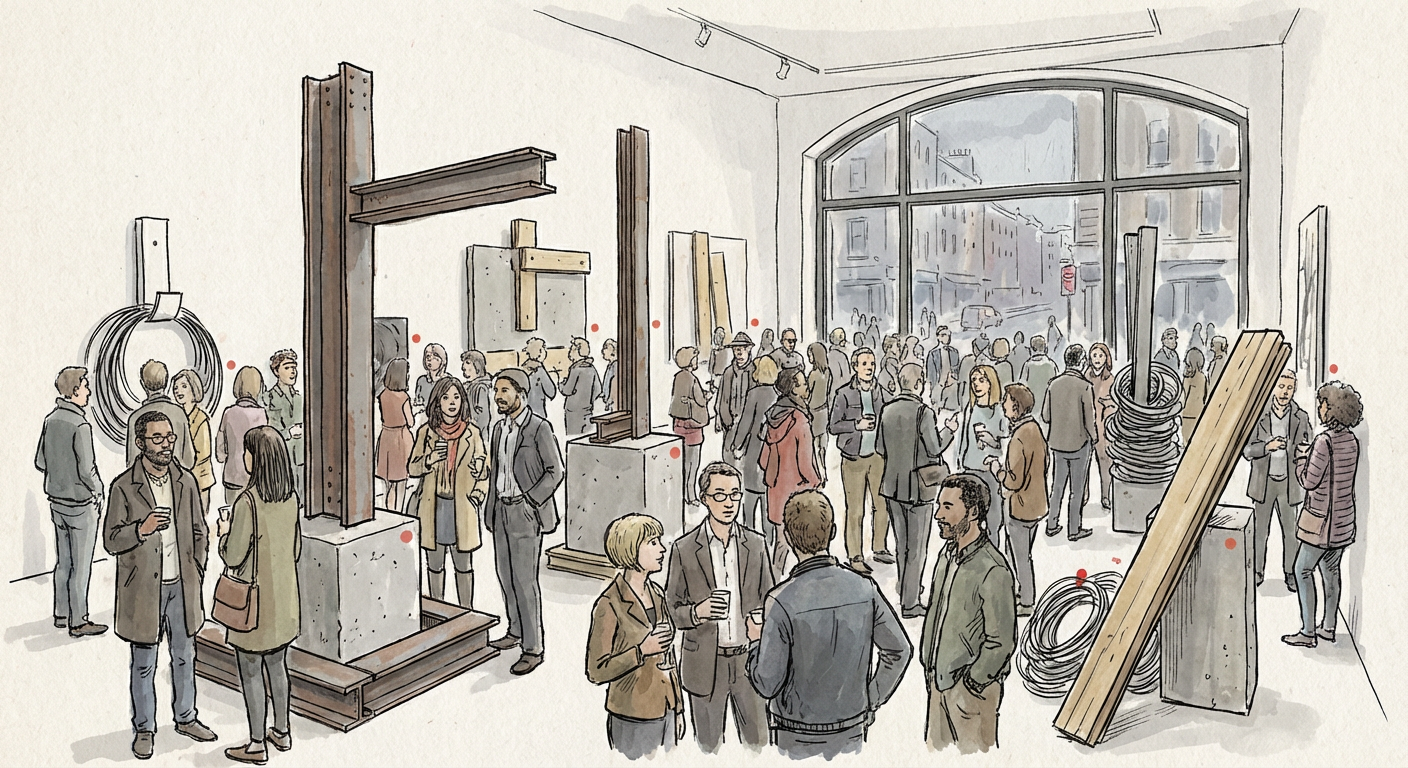
The institutional validation came quietly but decisively. In February 2026, London’s Sadie Coles HQ mounted a group show featuring seven artists working exclusively in industrial construction materials. The gallery, known for its curatorial eye and its refusal to chase trends, sold out its entire inventory on opening night. Not a single piece remained. This wasn’t the art world acknowledging a trend. This was the art world absorbing a genuine shift in sculptural language.
Why This Moment, Why This Material
Every material contains ideology. Ceramics, in its contemporary iteration, was about healing, about slowness, about the hand returning to something authentic in a world that felt too mediated. It was therapeutic. It was also, inevitably, absorbed into the wellness economy and sold back to us as another form of self-care consumption.
Ferro cement doesn’t make that bargain. You can’t center a ferro cement practice on self-care. It’s not soothing to work with. It’s messy, toxic in ways that require respect, dangerous if you’re careless. It demands you engage with chemistry, with structural integrity, with the actual physics of how things hold together. There’s no wellness narrative that can quite contain it.
There’s also something deeply political about watching artists turn to the materials of infrastructure, of labor, of the quotidian systems that hold our cities together. In a moment when capitalism has proven remarkably adept at absorbing any countercultural gesture, when every handmade object eventually finds itself for sale on a carefully curated marketplace, ferro cement offers something that resists that narrative. It references the unglamorous, the essential, the material world that doesn’t need to perform its authenticity.
This doesn’t mean ferro cement won’t eventually become commodified. It probably will. The cycle suggests it. But for now, in this particular moment, it exists in that sweet spot where genuine artistic exploration and underground aesthetic practices overlap. The artists working in this material aren’t doing it because it’s trending. They’re doing it because it’s true.
What’s Next, and What It Means to Pay Attention
The ceramics renaissance taught us something valuable, even as it peaked and declined. It showed that the underground still has the power to shape what reaches the mainstream, that aesthetic movements still percolate upward from real communities of practice rather than downward from marketing departments. The fact that we can trace this shift, from pottery wheels to industrial materials, from handcraft to structural sculpture, tells us that paying attention to what’s happening three months before the trend articles land still matters.
The artists working in ferro cement right now are building the visual language of the next two to three years. They’re learning the material, pushing its possibilities, figuring out what it can express that nothing else can. Some of them will burn out. Some will get absorbed into galleries and lose whatever made their work vital. Some will keep working in basements and warehouses, refining a practice that might never reach a mainstream audience. That’s the nature of genuine cultural work.
What matters is that the migration is happening. The energy that was flowing into pottery studios is redirecting toward materials that demand something different. It’s a small shift in the grand scheme of culture. But it’s the kind of shift that, if you’re paying attention, tells you everything about where we are and where we’re headed. If you’ve been watching this transition unfold, I’d love to hear what you’re seeing in your own artistic communities. What materials are calling to you now?