There’s a particular kind of light you notice in Australian painting—a flat, bleaching sharpness that makes shadows sit like cutouts. It’s the same light you hear in a lot of Australian music, if you listen with that part of your brain that translates colour into tone. Not the songs about beaches and beer, but the stuff that sits further inland, emotionally speaking. The music that hums with distance and reserve, the same way a Fred Williams landscape holds itself together through restraint rather than declaration.
I’ve spent enough time staring at walls in regional galleries and nursing a beer in sticky-carpeted bandrooms to suspect the two forms share more than just a postcode. There’s a sensibility running through both—a kind of dry, observational patience that treats space as a material. Not the negative space of minimalist theory, but the actual, physical, terrifying space of a continent that doesn’t much care if you’re here or not.

The Long Gaze
Australian visual art has a complicated relationship with the horizon. From the Heidelberg School’s efforts to cram European pastoralism into a landscape that refused to cooperate, through to the Indigenous dot paintings that had been mapping the same ground for millennia with a completely different conception of space, the line where earth meets sky has always been a problem worth returning to. Russell Drysdale’s figures stand in front of it like they’re waiting for a bus that isn’t coming. Sidney Nolan’s Ned Kelly squares off against it, a black rectangle against a sky that offers no judgement.
You find the same long gaze in Australian music—that tendency to stare at something until it yields meaning, or until you accept it won’t. The Triffids’ Born Sandy Devotional is practically a series of landscape paintings set to reverb. David McComb’s lyrics don’t describe the Nullarbor so much as inhabit its psychology. There’s no rush to resolve anything. Songs stretch out, unhurried, the way a Jeffrey Smart painting will hold an empty freeway in perfect, unsettling stillness.
This isn’t about genre. It’s a posture. You can hear it in the way Paul Kelly’s voice sits slightly behind the beat, observing his characters with a painter’s detachment. In the patient, textural guitar work of Dirty Three, where Warren Ellis’s violin scratches at the edges of a melody like a dry brush on rough canvas. Even in more recent acts like The Necks, whose hour-long improvisations feel closer to colour-field abstraction than conventional song structure—pools of sound that shift slowly, demanding you adjust your sense of time.
Silence as Substance
One of the more irritating clichés about Australian culture is the idea that we’re laconic because we’re simple. The reality is more interesting: silence here is a deliberate artistic choice, a recognition that what’s left out does as much work as what’s put in. Think of the paintings of Clarice Beckett, whose fog-bound suburban streetscapes from the 1920s and ’30s are almost entirely composed of what she chose to omit. Figures dissolve into weather. The effect isn’t vagueness but a heightened attention to what remains.
You can trace a direct line from Beckett’s restraint to the production choices on records like Chain of Flowers by The Apartments, where Peter Milton Walsh’s voice floats in a wash of reverb that threatens to swallow it entirely. Or to the bruised minimalism of Sarah Mary Chadwick’s recent work, where piano and voice are laid so bare they feel almost confrontational. These aren’t artists who lack ideas. They’re artists who understand that Australian audiences don’t need everything spelled out. The gaps are where we live.
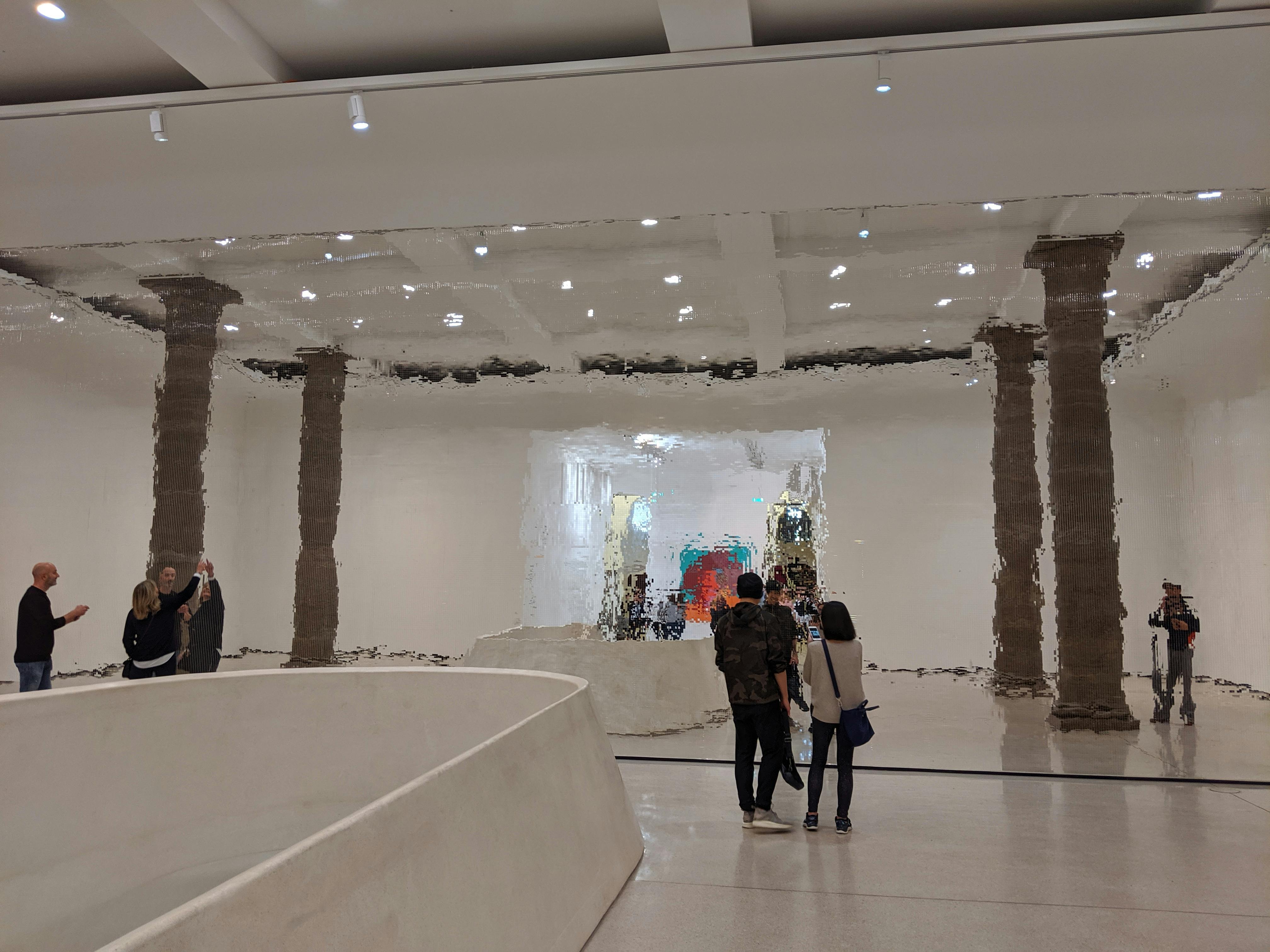
This comfort with negative space connects back to the oldest visual traditions on the continent. Indigenous Australian art has always understood that the space between marks carries meaning. The dotted patterns of Papunya Tula paintings aren’t just decorative; they encode relationships between land, story, and the bodies moving through them. The blank areas aren’t blank at all. They’re active. Listening to something like Gurrumul’s voice—that impossibly clear, self-contained tone—you get a similar sense of a presence that doesn’t need to fill the room to own it.
Materials That Show Their Age
There’s a particular affection in Australian art for materials that look like they’ve been through something. Rosalie Gascoigne built her career out of weathered road signs, faded soft-drink crates, and corrugated iron that had spent decades getting beaten by the sun. The work isn’t about nostalgia. It’s about the way surfaces carry time, the same way a voice does.
This aesthetic of honest decay runs deep in Australian music. Think of the worn-in quality of Nick Cave’s baritone on Skeleton Tree, a voice that sounds like it’s been sanded down by grief and cigarettes. Or the ramshackle charm of The Drones’ earlier records, where Gareth Liddiard’s guitar sounded like it was held together with electrical tape and resentment. The lo-fi recordings that came out of Melbourne’s ’90s scene—artists like The Cannanes or Minimum Chips—weren’t lo-fi because they couldn’t afford better production. They were lo-fi because the texture of the recording was part of the point. Like a Margaret Preston woodcut, the grain is the message.
Compare this to the gleaming surfaces of much American or European production, where polish signals professionalism. Australian artists have often treated polish with suspicion, as though too much sheen might obscure something essential. It’s a preference for the handmade over the manufactured, for the scratch in the vinyl over the pristine digital file. Not out of some quaint attachment to authenticity, but because the marks of use are evidence of life.
Irony and the Suburban Uncanny
Then there’s the suburbs—that great, sprawling, underexamined zone where most Australians actually live. Howard Arkley turned the brick-veneer dream into something gaudy and hypnotic, airbrushed houses vibrating with a colour palette borrowed from a service-station ice-cream freezer. There’s a knowingness to Arkley’s work, but it’s not quite sarcasm. It’s the same tonal ambiguity you find in the songs of Dick Diver or Courtney Barnett—a deadpan delivery that leaves you unsure whether you’re meant to laugh or wince.
Barnett’s lyrical style, with its flat-affect observations about mundane domestic life, is essentially Arkley in verse. She catalogues the contents of a fridge or a panic attack at a house viewing with the same detached fascination Arkley brought to patterned carpets and flyscreens. Neither is celebrating nor condemning. They’re simply looking, and letting the looking do the work.

This suburban uncanny has its musical roots in acts like The Go-Betweens, who understood that the most devastating emotional moments often happen in the least dramatic settings. A rental property in Brisbane. A share house in Melbourne. Forster and McLennan wrote about these spaces with a novelist’s eye for detail and a painter’s sense of composition—every object placed just so, every line of dialogue carrying weight. The ordinariness is the point. The suburbs aren’t a backdrop; they’re a character.
Landscape as Emotional Register
The most persistent thread connecting Australian visual art and music is the use of landscape not as scenery but as an emotional register. In Fred Williams’s paintings, the Murray River becomes a kind of nervous system, a thin scribble of water holding the whole composition together. In the music of The Middle East’s brief, brilliant career, the landscape of north Queensland functioned the same way—a presence that shaped the songs without ever being explicitly described.
This is distinct from the nationalist project of defining an Australian sound or an Australian school. Those efforts always end up feeling self-conscious and slightly embarrassed, like someone trying too hard at a party. The sensibility I’m talking about is more ambient than that. It’s a tendency, not a program. It shows up when artists stop trying to sound like London or New York or Nashville and start paying attention to the specific gravity of where they are.
You can hear it in the shimmering, heat-haze guitar tones of The Church’s Starfish, an album that sounds like a mirage. You can see it in the paintings of John Olsen, whose squiggling, energetic lines seem to map the movement of insects and thoughts with equal attention. Both are trying to capture something about being in a place that’s too big to take in all at once, so you focus on the small movements, the local weather, the way the light changes on a Tuesday afternoon in February.
FAQ
Why do so many Australian musicians seem to reference visual art or painters in their work?
Part of it is the smallness of the scene—musicians and visual artists often move in the same circles, share the same cheap-rent neighbourhoods, drink at the same bars. But there’s also a shared problem: how to make work that feels true to this place when the dominant cultural models come from elsewhere. Painters like Drysdale and Nolan solved that problem a generation before the musicians did, so there’s a sense of inheritance. When Nick Cave writes about a “sick rose” or Gareth Liddiard name-checks Arthur Boyd, it’s not showing off. It’s acknowledging a lineage.
Is this sensibility unique to Australia, or do other post-colonial cultures share it?
There are parallels with Canadian art, particularly the way artists like Neil Young or the Group of Seven deal with vast, indifferent landscapes. And you could make a case for a similar dynamic in parts of New Zealand. But the specific combination of light, distance, and a certain defensive irony feels particularly Australian. It’s a sensibility shaped as much by the suburbs as the outback—by the tension between the wide brown land of mythology and the quarter-acre block of reality.
Does this connection between music and visual art still hold for younger Australian artists?
It does, though it’s less about direct influence and more about a shared set of conditions. Current artists like Julia Jacklin or Stella Donnelly work with a kind of emotional precision that has more in common with contemporary painters like Del Kathryn Barton than with any obvious musical forebear. The concerns shift—more inner landscape than outer—but the observational patience remains. The internet hasn’t erased the specific gravity of place; if anything, it’s made it more noticeable when an artist actually has it.
What ties all this together, I think, is a particular kind of attention. Not the attention that comes from concentration, but the attention that comes from being stuck somewhere for a long time with nothing much to do but look. Australian art and music both come out of that looking. The landscape doesn’t offer easy drama. It offers itself, repeatedly, in different light. The best work accepts that offer and doesn’t try to gild it. It sits with the dust and the drone and trusts that if you pay enough attention, something will shift—a colour, a chord, a shadow, a silence—and that’ll be enough.