The Invisible Infrastructure of Cool
Every city has two maps. The first one appears on Google, with its neat grid of streets and officially designated landmarks. The second exists only in the collective memory of those who know where to look after midnight. This shadow cartography marks the locations where subcultures actually live and breathe: the basement venue that hosts experimental electronic acts, the community center where local poets gather every third Thursday, the corner bodega that doubles as an impromptu gallery for emerging street artists.
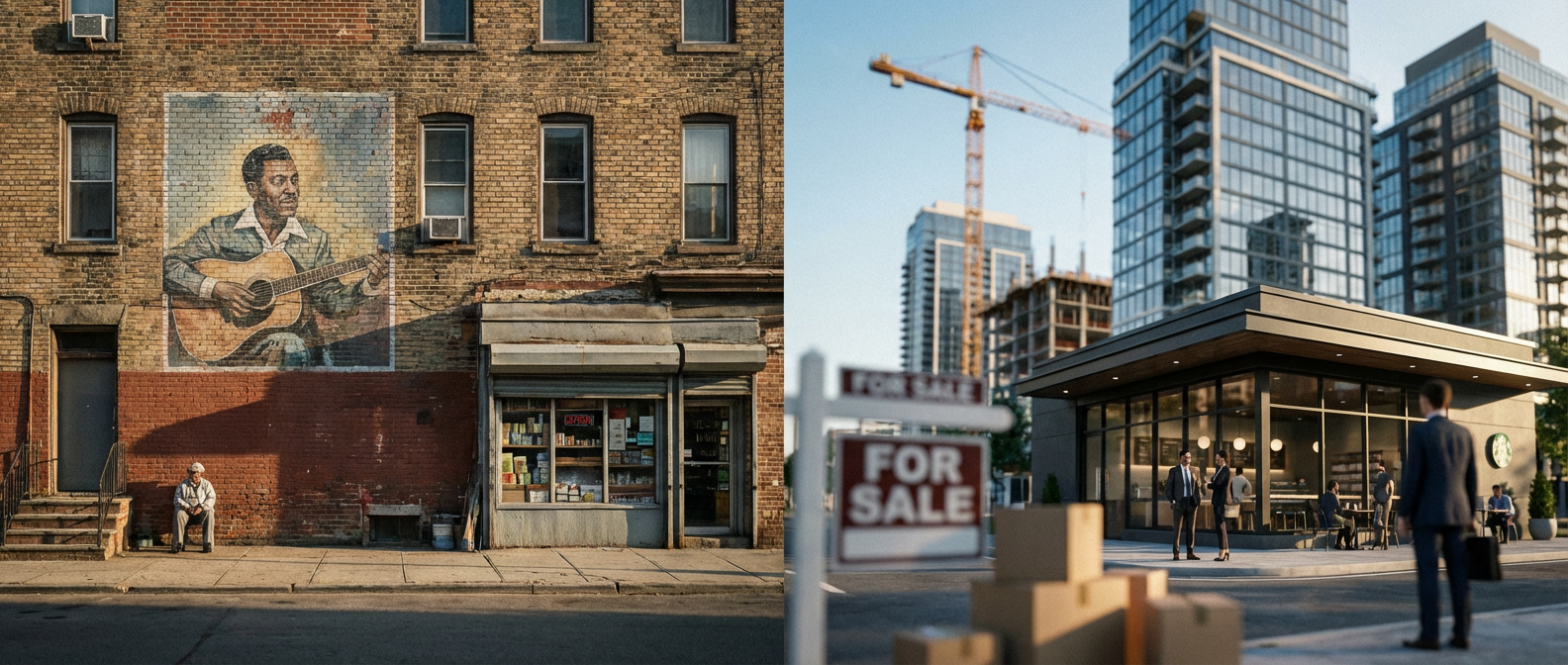
This second map runs on totally different rules than the first. Its landmarks shift and change organically, responding to rent prices, noise ordinances, and the delicate ecosystem of word-of-mouth networks. A single venue closing can redirect entire cultural flows, sending ripple effects through communities that took decades to build. When gentrification arrives, it doesn’t just change addresses and demographics. It tears apart this invisible infrastructure piece by piece, replacing it with a sanitized version that looks like the original but feels nothing like it.
Here’s the thing about subcultures: they don’t just need space, they need specific kinds of space. The DIY venue that can handle a 200-person show without noise complaints. The rehearsal space with 24-hour access and electrical capacity for a full PA system. The community garden where drag queens can host outdoor fundraisers without permits. These spaces emerge from years of negotiation between cultural practitioners and property owners who either don’t know or don’t care about their tenants’ activities. It’s those pockets of benign neglect where creativity actually flourishes.

The Economics of Cultural Displacement
When we talk about gentrification’s impact on culture, we usually focus on the visible losses: the beloved bookstore that becomes a boutique, the legendary club that turns into luxury condos. But the real devastation happens in spaces most people never knew existed. The warehouse complex that housed six different artist collectives gets converted to loft apartments. The strip of auto repair shops that quietly hosted raves in their back lots gets rezoned for mixed-use development. These losses rarely make headlines because mainstream media never covered these venues in the first place.
The economics driving this displacement work with brutal efficiency. As neighborhoods become “desirable,” property values rise, and landlords face pressure to squeeze maximum rental income from every square foot. The artist collective paying $800 monthly for a massive warehouse space suddenly gets an eviction notice when that same space could rent for $8,000 to a tech company. The community organization that’s been running on a handshake lease for fifteen years discovers their building has been sold to developers who see nothing but square footage and zoning potential.
What makes this particularly maddening is how market logic turns cultural activity into a commodity to be optimized rather than an ecosystem to be sustained. The new establishments that replace displaced venues often steal their aesthetic and cultural cache while eliminating the conditions that made the original spaces meaningful. The result is what sociologist Sharon Zukin calls “boutique multiculturalism”: diversity as branding rather than lived experience, culture as consumption rather than community practice.
The Ripple Effects of Creative Ecosystems
The relationship between subcultures and their physical spaces goes way deeper than simple economics. These venues work as cultural laboratories where new forms of expression develop through sustained experimentation and community feedback. The monthly poetry slam that becomes a launching pad for spoken word artists. The gallery collective where emerging painters develop their visual language through group critiques and collaborative exhibitions. The music venue where local bands refine their sound through regular performances before audiences who understand the genre’s evolution.
When these spaces disappear, they take with them not just current activities but future possibilities. The teenager who might have discovered experimental theater through a community workshop never gets that exposure because the space no longer exists. The musician who could have connected with like-minded collaborators at a weekly open mic loses that opportunity when the venue closes. Cultural development doesn’t happen in isolation. It needs sustained interaction between practitioners, audiences, and spaces that can handle risk-taking and failure.
This ecosystem effect explains why simply moving cultural activities to new venues rarely works as intended. The specific combination of factors that made a space culturally productive—its location, accessibility, acoustic properties, community connections, and informal governance structures—can’t be easily replicated elsewhere. Even when displaced communities manage to find new spaces, they often lose the networks and audiences that took years to develop, forcing them to rebuild from scratch in environments that may be less supportive of experimental work.
Resistance, Adaptation, and New Strategies
These challenges haven’t stopped subcultures from developing creative strategies to survive gentrification’s advance. Some communities have embraced more nomadic approaches, organizing events that move between different venues to avoid becoming dependent on any single location. Others have formed cooperative ownership structures, pooling resources to purchase buildings before developers can snatch them up. The most successful adaptations often involve building political coalitions that can advocate for zoning protections or community land trusts that remove property from speculative markets.
Technology has also enabled new forms of cultural organization that exist partially outside traditional spatial constraints. Online platforms help scattered communities maintain connections even when physical gatherings become more difficult to organize. Social media networks allow for rapid mobilization around temporary events and pop-up venues. Digital tools make resource sharing and collective decision-making easier among groups that might previously have required regular in-person meetings to stay cohesive.
But these technological solutions can’t fully replace the irreplaceable aspects of physical cultural spaces. The spontaneous collaborations that emerge from chance encounters. The tacit knowledge transmitted through apprenticeship and observation. The sense of belonging that develops through repeated presence in shared spaces. Digital networks complement but cannot substitute for the embodied experiences that drive cultural innovation.
Mapping New Possibilities
Understanding gentrification’s impact on subcultures means recognizing that this isn’t simply about preserving the past. The most vital cultural communities have always been those capable of adapting to changing conditions while maintaining their core values and practices. The question isn’t how to freeze existing cultural landscapes in place, but how to create conditions where new forms of cultural expression can emerge and evolve without being immediately displaced by economic pressures.
This might involve advocating for policies that protect affordable cultural spaces through zoning regulations or tax incentives. It could mean supporting community land trusts that remove cultural venues from speculative real estate markets. It might require developing new models of cultural funding that prioritize long-term community development over short-term project grants. Most importantly, it demands recognizing that cultural vitality isn’t a luxury amenity but an essential component of urban life that requires intentional protection and cultivation.
The ghost maps of displaced subcultures remind us that cities lose more than character when they prioritize development over cultural preservation. They lose the conditions necessary for innovation, community formation, and the kind of creative experimentation that ultimately benefits everyone. What other invisible cultural geographies exist in your city that deserve protection and support? The answer might be hiding in plain sight, waiting for someone to pay attention to the second map.