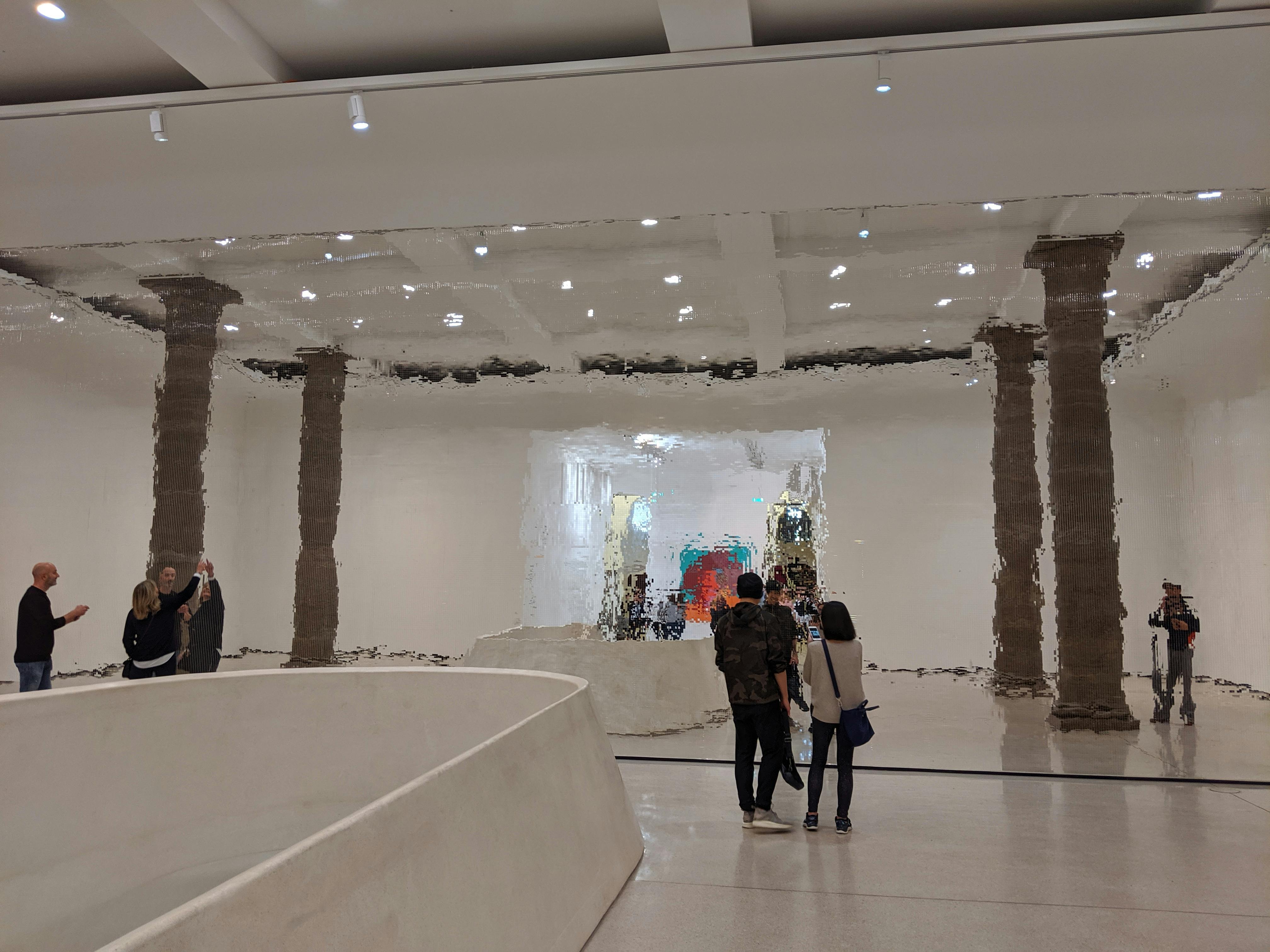
I stood in a gallery last month and watched a man take a photo of a painting without once looking at the actual canvas. His phone did the seeing, the screen did the filtering, and somewhere in a data centre an algorithm got ready to log his double-tap as a vote of confidence. The painting hung there, patient and unobserved, like a party guest who’s already been tagged and discarded.
This isn’t just a story about bad gallery manners, though there’s plenty of that. It’s about how we’ve quietly handed our aesthetic judgment over to a set of metrics built to sell ads, not to measure meaning. Instagram never meant to become the world’s loudest art critic, but here we are.

The Currency of the Like
There’s a particular absurdity in watching the art world—supposedly a refuge from the transactional grind—pick up the logic of a social media dashboard. Galleries now talk about “engagement” the way supermarkets talk about footfall. Artists check their post performance before they check their own gut response to a finished piece. A work that racks up a thousand likes in an hour is, by some weird unspoken consensus, more valid than one that gets twelve.
And that has consequences. I’ve talked to painters who’ve started cropping their canvases square because rectangular compositions don’t fit the grid. Sculptors who light their work for phone screens rather than the human eye. The platform doesn’t just reflect artistic output; it reshapes it, quietly and thoroughly, until the medium itself starts bending toward what’s shareable.
What the Numbers Actually Measure
Let’s be blunt about what Instagram metrics actually capture. They measure how fast an image stops a thumb. They measure the odds that someone will tap a heart icon before scrolling on to a video of a dog in a hat. They measure, in other words, how efficiently a piece of visual content works as a vehicle for a microsecond of attention—not its depth, not its craft, not its ability to unsettle or console.
Art has always been tangled up with commerce and status, but there’s a gap between a patron commissioning a portrait and a platform algorithm deciding which work surfaces based on predicted “time on post.” The former is a human transaction with all its messy biases. The latter is a statistical optimisation process run by a machine that can’t tell a Rothko from a risotto photograph.

When the Algorithm Becomes the Editor
The problem isn’t that people use Instagram to share art. That’s fine, and often genuinely useful for artists who need to reach an audience without a gallery’s backing. The problem is the feedback loop that turns popularity into a stand-in for quality. The algorithm rewards content that keeps users glued to the app, which means it rewards art that’s instantly legible, emotionally unambiguous, and visually punchy enough to stop a scroll. Subtlety doesn’t get a look in.
I think about the paintings I’ve loved most—the ones that took weeks to settle into my head, the ones I didn’t fully get on first viewing. None of them would survive the Instagram test. They’d be swiped past in a fraction of a second, rejected by a neural pathway that wasn’t built for contemplation. And because we’re suggestible creatures, we’d start to believe, over time, that the things we swipe past aren’t worth pausing for.
The Flattening Effect
Metrics flatten. That’s their job. A complex, ambivalent artwork gets reduced to a set of digits that sit right alongside the digits for a breakfast smoothie bowl. The context collapses. The lighting, the scale, the texture, the weirdness—all of it gets compressed into a thumbnail and a tally. When we then use that tally to decide what’s worth seeing in person, we’re letting the compressed version dictate our experience of the real thing.
This flattening doesn’t just hit audiences. It hits critics too, or whatever passes for criticism in the age of the influencer listicle. I’ve seen reviews that read like analytics reports: “This piece generated significant online conversation,” as if that were a mark of aesthetic achievement rather than a mark of successful content marketing. The work itself disappears behind its own metadata.
The Counter-Argument (and Why It Falls Short)
Whenever I bring this up, someone points out that Instagram has democratised art. It’s given exposure to artists who’d never get past a gallery’s gatekeepers. This is true, and I don’t dismiss it. But democratisation and metric-obsession aren’t the same thing. You can have the former without the latter. The problem isn’t that anyone can share their work; it’s that the platform’s incentive structure pushes everyone toward the same kind of work.
Democratisation also implies a level playing field, but the algorithm is not a level field. It’s a terrain shaped by engagement patterns, which are shaped by platform design, which is shaped by the business model of a company that sells user attention to advertisers. Calling that democratic is like calling a casino floor a meritocracy.
The Artist’s Dilemma
Artists are genuinely caught. Ignore Instagram and you risk invisibility. Play the game and you risk turning your practice into a content calendar. I’ve known painters who’ve built substantial followings only to find that the audience they’ve cultivated wants more of the same—brighter colours, simpler compositions, quicker emotional payoffs. Diverging from the formula means watching the numbers drop, and watching the numbers drop feels, in the moment, like failure.
This is the quiet tragedy of metric-driven art: it trains artists to distrust their own instincts. The internal compass gets swapped for a dashboard. The question shifts from “Is this good?” to “Will this perform?”—and those two questions have very little in common.
What’s Lost When We Outsource Judgment
Something happens to a culture when it starts evaluating creative work mostly through numbers. The things that can’t be counted—emotional resonance, intellectual provocation, formal surprise—start to seem less real. We get suspicious of our own responses unless they’re validated by a digit. “I liked it” becomes a weaker statement than “It got fifteen thousand likes.”
That’s a loss, and not a small one. Art is one of the few domains where we’re allowed a private, unquantified experience. It’s supposed to be a space where you can stand in front of something and not know exactly how you feel—where uncertainty is a feature, not a bug. When we submit that experience to the tyranny of the like count, we give up something essential.
A Modest Proposal
I’m not saying we all delete our accounts and go back to carrier pigeons. But we could stand to be more deliberate about how we let metrics shape our aesthetic lives. We could notice when we’re reaching for our phones in a gallery before we’ve actually looked. We could pay attention to the art that doesn’t photograph well, the work that resists the grid, the pieces that need time and quiet rather than a quick double-tap. We could, in short, practice a little scepticism toward the numbers and a bit more trust in our own slow, imperfect perception.
The painting I saw that man photographing was, as it happens, quite good. I stood with it for a while after he walked off. It was a landscape, muted and strange, with a sky that seemed to be thinking about rain. It didn’t amount to much on a screen. But in the room, under the lights, it had a presence no phone could trap and no metric could measure. That’s the kind of art I want to keep showing up for—the kind that asks for your attention, not just your thumb.
Frequently Asked Questions
Does Instagram have any positive role for artists?
It does. The platform can help artists reach audiences they’d never access through traditional gallery systems, and for many emerging creators, it functions as a portfolio and networking tool. The issue isn’t the existence of the platform but the way its metric-driven incentives tend to narrow the range of what gets made and celebrated. A tool isn’t neutral when its design rewards a very specific kind of output.
How can I tell if I’m judging art by its metrics rather than its merit?
A useful test: ask yourself whether your impression of a work would shift if you saw it in person, at full scale, without any knowledge of its online reception. If the answer is yes—if you’d feel differently standing in front of it—then the metrics are doing some of the heavy lifting for your judgment. Pay attention to that gap. It’s often where the more interesting response lives.
Are there alternative platforms that serve artists better?
Several platforms position themselves as more artist-friendly—sites like Are.na or dedicated portfolio services—but they typically lack the audience scale of Instagram. The deeper solution isn’t finding a better platform but cultivating a healthier relationship with the metrics themselves. That means valuing direct experience over social proof, and seeking out art in spaces—galleries, studios, printed pages—where the numbers can’t follow.