The Uncool Kids Have the Best Distribution Network Now
There’s a specific moment when you know a trend has stopped being underground and started becoming infrastructure. For zines in 2025, that moment arrived sometime around March, when Printed Matter’s annual art book fair in New York reported a 28 percent jump in first-time zine exhibitors compared to just two years prior. But here’s what matters more than the raw number: nearly every one of these new vendors had explicitly branded their work as human-made only, AI-free, no algorithms involved. The marketing language wasn’t apologetic or defensive. It was aggressive. It was the whole point.

This wasn’t nostalgia wearing a trendy outfit. Something stranger had happened. A genuine rebellion had calcified into market logic. When independent zine makers started stamping their work with declarations of human authenticity, they weren’t appealing to some niche faction of Luddites. They were creating scarcity value in a moment when digital reproduction had theoretically eliminated scarcity altogether. The irony was so thick you could laminate it.
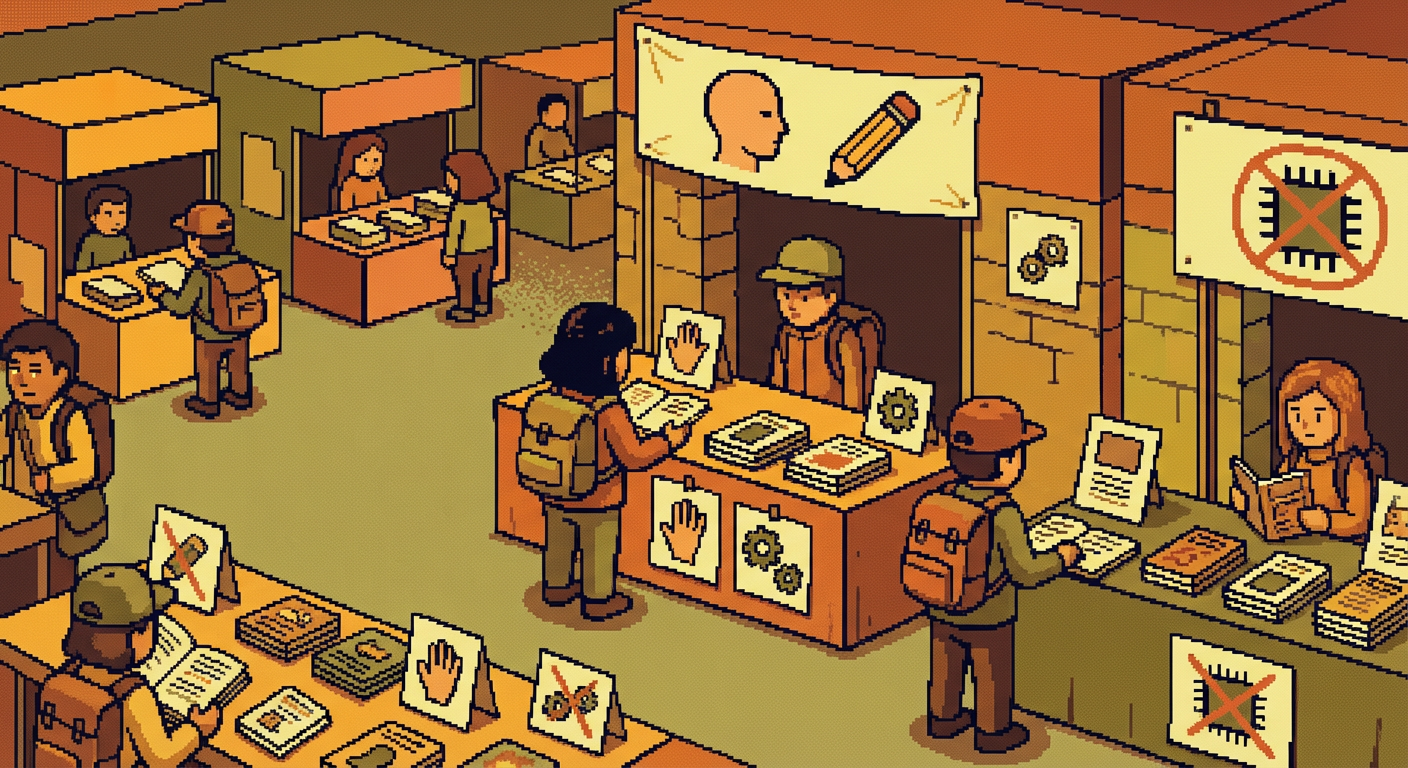
When Handmade Became a Luxury Good
The numbers tell a story about what happens when you position human labor as an alternative rather than a default. Etsy’s internal data, released in late 2025, showed that zines and handmade print publications tagged as AI-free commanded a 37 percent price premium over identical products without the label. That’s not a small bump. That’s the kind of margin that signals something has fundamentally shifted in how people value objects in a post-scarcity content environment. People were literally paying more for the verification that a human hand had touched the thing they were buying.
This created a strange economic logic where the most profitable way to sell independent print was to make a point about resistance. The tactile imperfections that once signaled cheapness or amateurism now read as proof of authenticity. Crooked typography became a feature rather than a bug. Paper texture became a selling point rather than an afterthought. You can trace the exact moment when the limitations of handmade production stopped being limitations and started being brand attributes.
The irony was recursive. Capitalism had figured out how to monetize anti-capitalist aesthetics so effectively that the aesthetics themselves became complicit. But that didn’t stop anyone from making zines. If anything, it accelerated the whole ecosystem.
The ‘No Robots’ Collective Built Something That Actually Stuck
The No Robots collective started in Brooklyn in mid-2024 as what looked like another art world affinity group. By January 2026, it had spread into something genuinely distributed: over 3,000 registered zine makers across 14 American cities. That’s not a social media following. That’s actual infrastructure. In February 2026, they hosted their first national print fair in Chicago, and the response suggested that something real had formed where online discourse usually just produces temporary alliances.
What made the No Robots network different from previous zine communities wasn’t the ideology, which was fairly standard post-capitalist critique. It was the infrastructure. They developed shared distribution channels. They created regional hubs that functioned like production facilities. They established a verification system that actually meant something because it was peer-enforced rather than algorithm-mediated. You could hold a physical stamp that proved your work had been vetted by actual humans. It sounds absurd until you realize that’s exactly how all certification systems worked before we decided to automate everything.
The collective’s growth suggested that the appetite for analog networks was less about nostalgia and more about exhaustion with algorithmic mediation. People wanted to know who was making the things they were buying. They wanted distribution that didn’t require feeding data into surveillance infrastructure. They wanted the transaction to stop at the moment of exchange rather than continuing indefinitely as behavioral metadata.
The Generational Vote Against the Aesthetic Machine
According to the Society of Publication Designers 2025 industry report, 68 percent of independent print designers under 30 cited resistance to AI aesthetics as a primary motivation for choosing analog production methods. That’s not a fringe position. That’s a generational stance. Young designers weren’t making zines because they couldn’t afford better tools. They were making zines because they actively rejected the aesthetic logic that generative models had begun to enforce across the digital landscape.
The reasoning was straightforward if you spent any time in design circles in 2024 and 2025. AI-generated imagery had become so ubiquitous, so algorithmically normalized, that actual human visual choice had started to feel radical by comparison. An intentional design decision now read as resistance. Asymmetry read as refusal. The specific weirdness that emerges when a human being wrestles with constraints read as honest in a way that algorithmic smoothness could never achieve. The tools had changed so much that incompetence had started to look like integrity.
At London’s Tenderbooks, an independent bookshop that had survived two decades of digital disruption through sheer stubbornness and good taste, zine sales outpaced artist monograph sales for the first time in the shop’s 12-year history in 2025. The zine section alone saw a 55 percent year-over-year revenue increase. This wasn’t a market correction. This was a wholesale pivot in what customers actually wanted to spend money on when they had the choice.
What Comes Next When the Underground Isn’t Underground Anymore
The interesting question now isn’t whether zines are back. They’re clearly back. The interesting question is what happens to a movement when it becomes profitable and distributed simultaneously. The Printed Matter NYC’s 2025 art book fair recap highlighted something that most trend analysis glosses over: growth in alternative media doesn’t necessarily mean dilution or co-optation, at least not immediately. It can mean that the infrastructure finally exists to support what people actually wanted to make all along.
The 2025 print underground rebellion won’t stay underground for long, if it hasn’t already escaped those boundaries. But unlike previous cycles where underground movements got absorbed into mainstream aesthetics, this one carries a built-in rejection logic. You can’t make zines AI-friendly without destroying their entire value proposition. The ethos is baked into the material itself. That doesn’t make the whole thing pure or free from commodity logic. But it does mean the contradiction is at least visible and acknowledged rather than hidden behind a marketing veneer.
The question now is whether this infrastructure can sustain itself once the novelty wears off and the premium pricing normalizes. Whether human-made authenticity remains a compelling value proposition after it’s been monetized and scaled. Whether the zine makers currently riding this wave understand that their work is participating in its own commodification. The answer will probably determine whether this becomes a lasting cultural shift or just another trend that gets excavated in five years as proof that people once believed in physical objects.
What do you think is actually driving this shift? Is it genuine exhaustion with algorithmic culture, or just the familiar cycle of capitalism turning resistance into product? Hit me up in the comments or send me your own zine if you’re making work that fits this moment. I’m always looking for the next thing everyone else is going to care about in eighteen months.