The Great Flattening of 2019-2023
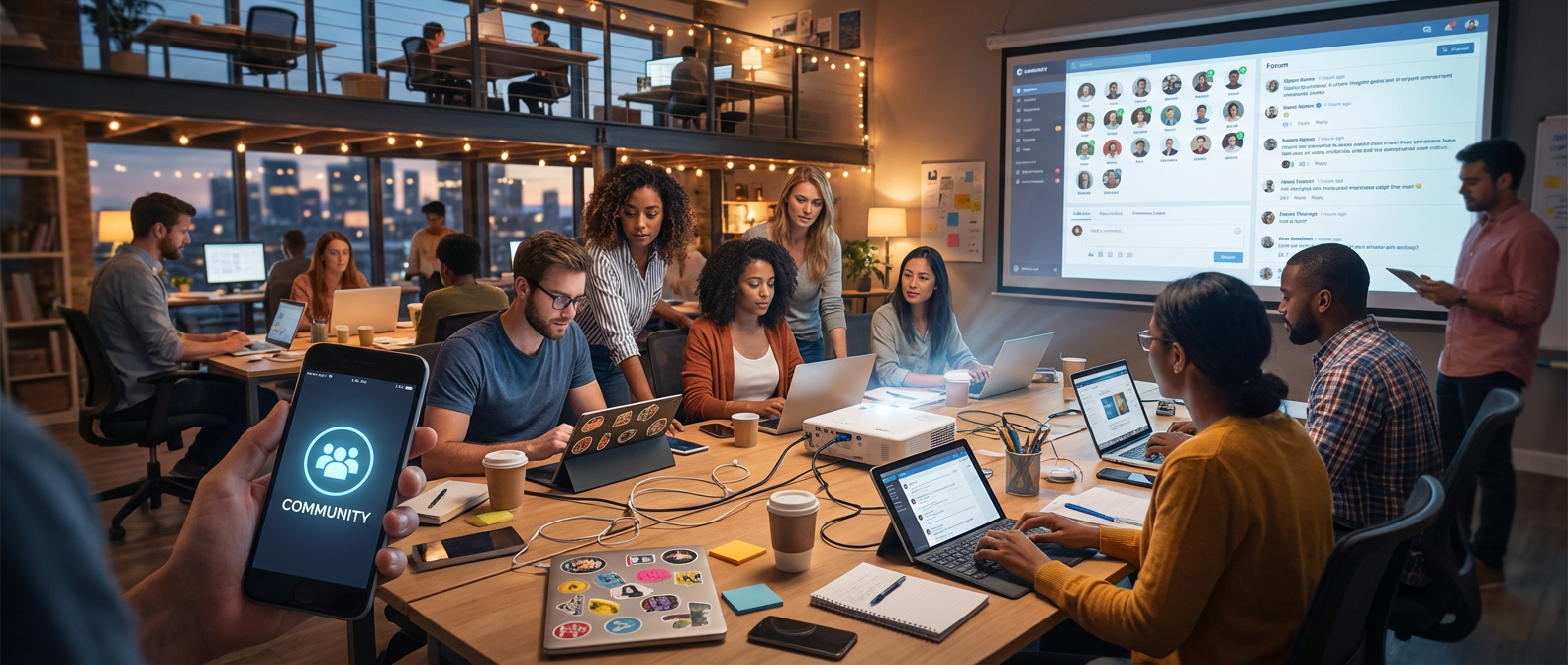
Something fundamental shifted in how we form communities online between 2019 and 2023, and it wasn’t just the pandemic forcing us into digital spaces. The algorithmic consolidation of platforms like Instagram, TikTok, and Twitter created what I call the Great Flattening. During this period, niche communities were either absorbed into mainstream visibility or pushed so far underground they became nearly invisible to casual discovery.
Consider what happened to vaporwave culture. Once a thriving ecosystem of obscure producers, visual artists, and dedicated forums, it got systematically mined by corporate aesthetics departments and influencer accounts until the original community scattered. They fled to private Discord servers and invite-only SoundCloud collectives. The visual language remains everywhere. Those purple and pink gradients sell everything from energy drinks to meditation apps. But the actual culture has retreated to spaces that require genuine investment to access.
This pattern repeated across dozens of micro-scenes. Cottagecore got turned into Target home goods. Dark academia became a Shein clothing category. Y2K revival morphed from genuine archival research into fast fashion nostalgia. Each cycle follows the same trajectory: authentic community formation, organic growth, algorithmic amplification, corporate extraction, community exodus.
The New Underground: Discord Republics and Group Chat Nations
Where did these communities go? They didn’t disappear, they evolved. Modern digital subcultures have learned to build infrastructure that’s immune to both algorithmic manipulation and corporate appropriation. The most interesting cultural stuff now happens in spaces that feel deliberately anti-viral. Friend-only Instagram accounts with 47 followers documenting experimental music scenes. Invite-only Discord servers organizing pop-up events. Group chats that function like curated cultural salons.
Take the current state of electronic music culture in major cities. Spotify playlists and festival lineups suggest a bland landscape of big-room house and algorithmic ambient, but the actual innovation happens in networks that operate like secret societies. I know producers in Detroit whose most experimental work only gets shared in a WhatsApp group of twelve people. There are visual artists in Berlin whose installations are documented exclusively through finsta stories that disappear after 24 hours.
These aren’t just exclusive social clubs. They’re preservation societies. Members understand that their cultural practices need protection from the flattening effect of mainstream platforms. They’ve developed sophisticated systems for maintaining authenticity while still allowing for growth and evolution. Think of them as cultural seed banks, maintaining genetic diversity in an increasingly bland digital ecosystem.
Platform Migration and the Art of Strategic Obscurity
The most sophisticated communities have mastered what I call strategic obscurity. The deliberate creation of barriers to entry that filter for genuine engagement while remaining invisible to trend-mining algorithms. This isn’t gatekeeping for its own sake, it’s a survival mechanism developed in response to the repeated colonization of their spaces.
Watch how experimental fashion communities operate across multiple platforms simultaneously. They use Instagram for highly curated visual documentation, Twitter for real-time discourse and coordination, Discord for deeper relationship building, and increasingly, platforms like Are.na and Cosmos for actual knowledge sharing and archival work. Each platform has a specific function in maintaining community coherence while preventing any single point of failure or corporate capture.
The most resilient communities have also developed internal economies that exist parallel to mainstream creator economy structures. Instead of monetizing attention through brand partnerships and sponsored content, they create value through mutual aid networks, skill sharing, collaborative projects, and alternative economic models like time banks and resource pooling. When your community’s value system is fundamentally incompatible with platform monetization, you build different infrastructure.
The Return of Friction and the Curation Renaissance
Perhaps the most significant development in recent digital community formation is the deliberate reintroduction of friction. After a decade of platforms optimizing for frictionless consumption and viral spread, many communities are embracing barriers, gatekeeping, and curation as essential tools for maintaining cultural integrity.
This manifests in fascinating ways. Some of the most innovative music discovery happens through newsletters with waiting lists and application processes. Visual art communities require portfolio submissions and sponsor referrals. Book clubs demand essays about your reading history. These aren’t arbitrary hoops, they’re filtering mechanisms that ensure participants share fundamental values and commitment levels.
The curation renaissance goes beyond gatekeeping. It’s about creating contexts where cultural objects can exist with proper framing and institutional memory. When a rare electronic track gets posted in a carefully curated Telegram channel with historical context about the producer, the record label, and the broader scene it emerged from, it carries meaning that’s impossible to replicate on Spotify’s algorithmic shuffle. The friction creates space for education, appreciation, and genuine cultural transmission.
Building Worlds Beyond Surveillance Capitalism
The most ambitious digital communities are now explicitly positioning themselves as alternatives to surveillance capitalism’s attention economy. They’re not just creating alternative spaces, they’re modeling alternative relationships to technology, culture, and each other. These experiments deserve serious attention as potential blueprints for post-platform community formation.
I’ve watched reading groups evolve into mutual aid networks that coordinate everything from food distribution to technology repair workshops. Music collectives that started as SoundCloud repost chains now run tool libraries and skill shares. Fashion communities that began with fit pics are pioneering new models of clothing production and distribution that bypass fast fashion entirely.
These communities understand that cultural autonomy requires economic autonomy, which requires technological autonomy. They’re building infrastructure, social, economic, and technical, that can sustain cultural practices without depending on extractive platforms or exploitative economic models. It’s not about rejecting technology, it’s about insisting that technology work for human flourishing rather than corporate growth metrics.
The future of digital culture belongs to communities brave enough to remain small, weird, and unmonetizable. If you’re building something that matters, I want to know about it. Send me an email or find me in the usual places, the ones that haven’t been flattened yet.