The Algorithm Killed the Underground
Everyone’s talking about Banksy again, and it makes me want to throw my phone into the nearest gentrified coffee shop’s reclaimed wood counter. Not because Banksy isn’t brilliant—the anonymous artist’s work remains surgically precise in its cultural commentary—but because the conversation around street art has been so thoroughly commodified that we’ve forgotten what made it dangerous in the first place. We’ve mistaken the museum-friendly stencils for the revolution they once represented, sanitizing a movement that was born from the fundamental rejection of who gets to decide what art belongs where.
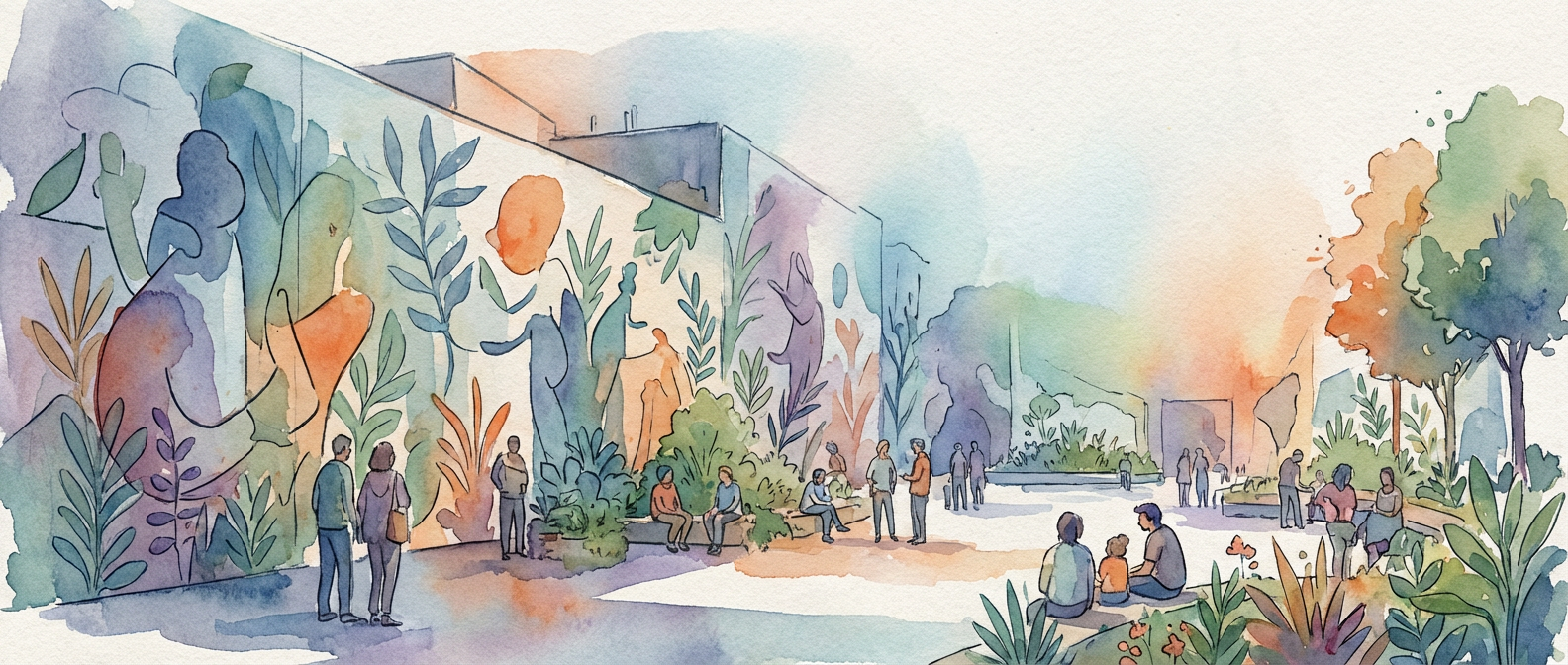
The moment that really mattered happened between roughly 2008 and 2012, in those weird spaces where economic collapse met digital connectivity. This wasn’t the birth of street art, obviously. Writers had been bombing subway cars since the 1960s, and wheat-paste artists had been reclaiming billboards for decades. But something clicked during those years that created perfect conditions for a movement that briefly threatened the entire logic of who owns public space.
The financial crisis had left cities pockmarked with empty lots and abandoned buildings, creating tons of canvases just as social media gave artists unprecedented ability to document and distribute their work without traditional gatekeepers. Municipal budgets for public art programs had evaporated, leaving communities hungry for visual culture that spoke to their actual experiences rather than the sanitized visions of urban planning committees.
The Perfect Storm of Conditions
What made this period special wasn’t just the art itself, but the ecosystem that supported it. Cities like Detroit, Berlin, and even neglected neighborhoods in New York and Los Angeles had become laboratories for artistic intervention. Property values were low enough that authorities often turned a blind eye to unauthorized murals, especially when they improved areas the city had essentially written off. Artists could work with relative impunity, and communities often welcomed the transformation of dead space into something alive and meaningful.
The tech changes happening at the same time were huge. High-quality cameras became accessible through smartphones, and platforms like Flickr and early Instagram provided distribution networks that bypassed traditional art world hierarchies. An artist in São Paulo could inspire someone in Prague within hours, creating a global conversation about public space that transcended geographic and economic boundaries. This wasn’t just about pretty pictures, it was about documenting the reclamation of urban environments by the people who actually lived in them.
The work from this period operated on multiple levels. JR’s massive black-and-white portraits transformed entire building facades into statements about dignity and visibility for marginalized communities. Blu’s politically charged murals in Europe were both aesthetic interventions and direct commentary on migration, capitalism, and state power. These weren’t decorative additions to urban space. They were argumentative, confrontational, and impossible to ignore.
The Institutionalization Machine
The tragedy, if we can call it that, is how quickly the institutional art world recognized the commercial and cultural capital embedded in this movement and began the process of extraction. By 2013, street art festivals were proliferating globally, offering artists legal walls and stipends in exchange for work that would attract tourists and raise property values. The same economic forces that had created the conditions for authentic rebellion were now co-opting its visual language for civic branding purposes.
Galleries began representing street artists, but the transition from illegal public work to legal commercial product fundamentally altered the meaning of the practice. When Shepard Fairey’s work hangs in the Smithsonian, it’s no longer about unauthorized intervention in public space, it’s about an artistic career trajectory that happened to begin with wheat paste and stencils. The radical potential of the medium gets neutered through legitimization, transformed from direct action into cultural commodity.
This isn’t to diminish the individual artists who made these transitions. Surviving as an artist under capitalism requires constant compromise, and there’s nothing inherently pure about remaining permanently underground. But the cultural moment that made street art politically and aesthetically powerful was dependent on its existence outside sanctioned spaces, its rejection of permission-based creativity, and its insistence that public space belongs to the public rather than to whoever holds the deed.
What We Lost in Translation
The current landscape of “street art” feels hollowed out, optimized for Instagram engagement rather than genuine intervention in urban space. Cities now commission murals as part of economic development strategies, using artistic production as a tool for neighborhood branding rather than community expression. The visual language remains, but the political content has been carefully extracted, leaving behind an aestheticized shell that attracts foot traffic and signals cultural coolness to potential investors.
Housing costs have eliminated many of the marginal spaces where authentic artistic communities could develop organically. The abandoned lots and cheap warehouse districts that provided both canvas and affordable living space for artists have been transformed into luxury developments, pushing creative communities further to the periphery or out of cities entirely. The economic conditions that enabled this cultural peak have been systematically eliminated by the very forces that learned to profit from the aesthetic it produced.
What remains exciting in contemporary practice tends to happen in contexts where the original conditions persist: in cities experiencing economic crisis, in neighborhoods where authorities lack the resources for intensive surveillance, or in political situations where artistic intervention carries genuine risk. The most compelling work continues to emerge from artists who understand that the medium’s power lies not in its visual impact alone, but in its capacity to challenge assumptions about who controls public space and how meaning gets created in urban environments.
The Archaeology of Rebellion
Documenting this moment requires recognizing that its importance lay not in individual masterpieces but in the temporary disruption of normal urban relations. For a brief period, cities became sites of widespread unauthorized creativity, where communities could articulate their own visions of what public space might look like and what stories deserved to be told on the largest possible canvases. The work was ephemeral by nature, painted over, weathered away, or demolished along with the buildings that supported it, but its impact on how we understand the relationship between art and urban space continues to reverberate.
The artists who emerged from this period often speak about the particular energy of working without permission, the way that illegality sharpened their focus and connected their practice to longer traditions of cultural resistance. There was a specific thrill in transforming abandoned spaces into temporary galleries accessible to anyone walking by, creating art that couldn’t be commodified because it existed only in relationship to its immediate environment and community context.
Understanding this cultural peak helps clarify what we’ve lost and what might still be possible. Every time a developer uses street art aesthetics to market luxury condos, we should remember when those visual languages represented genuine challenges to exactly those kinds of economic arrangements. Every time a city tries to attract tourists with sanctioned mural districts, we should recall when unauthorized artistic intervention actually transformed how communities understood their relationship to urban space. The moment may have passed, but the conditions that made it possible could emerge again, in different forms and different places, whenever communities decide that public space belongs to them rather than to capital.
If you’ve witnessed similar moments of cultural transformation in your own city, or if you’re tracking contemporary practices that maintain this spirit of genuine intervention, I want to hear about them. The institutional capture of street art doesn’t mean the impulse toward unauthorized creativity has disappeared, it just means we need to look harder to find where it’s happening next.